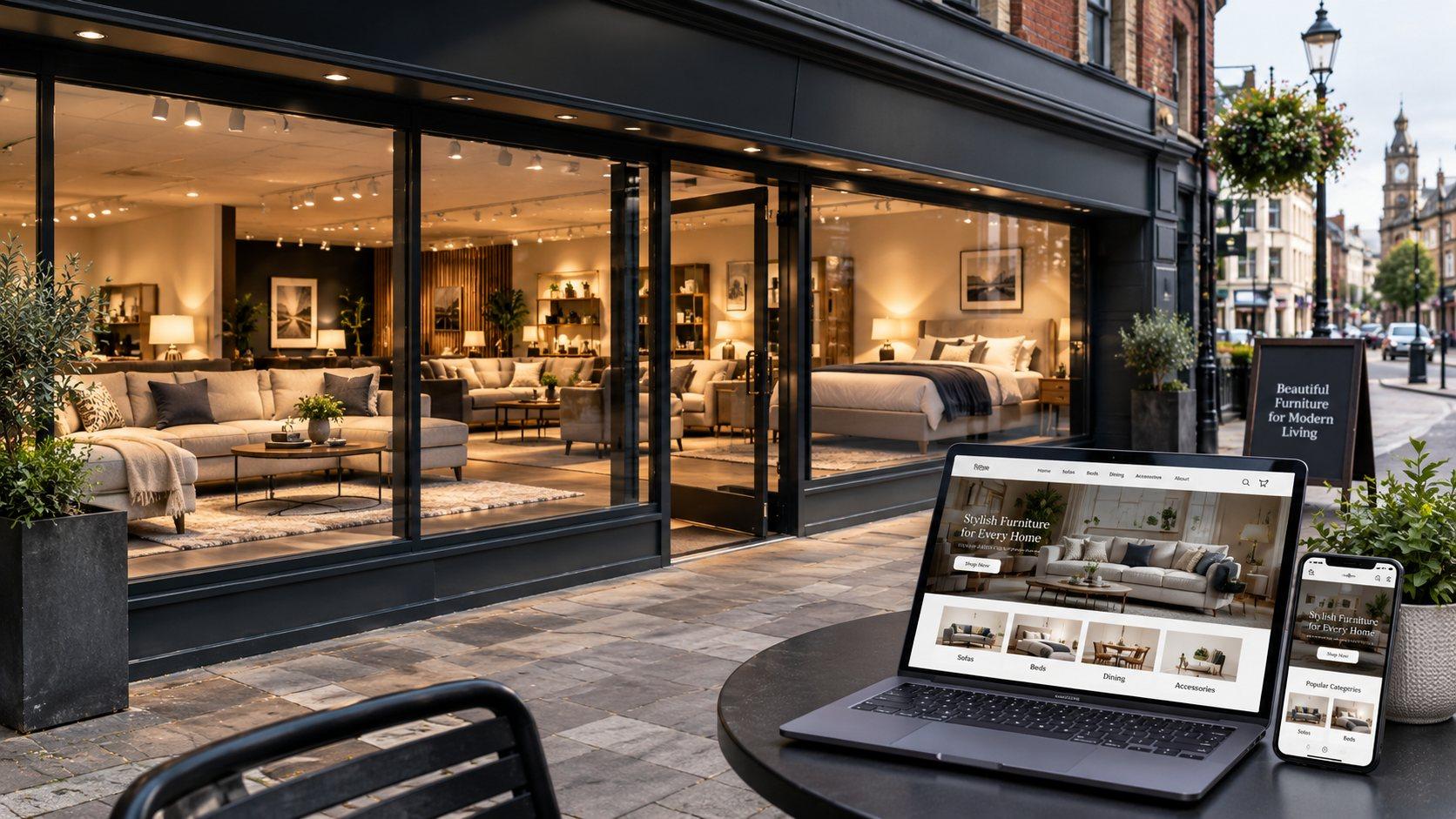
Facebook can be a useful marketing channel for an independent furniture shop.
You can post new sofas, showcase beds, announce discounts, share customer photos and answer questions directly through messages.
But there is a difference between having a social media presence and having a proper online home for your business.
For an independent furniture shop in Leicester, relying only on Facebook can make it harder for potential customers to properly explore what you sell, understand your business and take the next step.
A website doesn't have to replace Facebook. In most cases, it should work alongside it.
Facebook is useful, but it isn't a proper product catalogue
Furniture is a visual product.
People often want to see several photos, compare styles, check dimensions, understand available colours and learn whether delivery is available before they decide to contact a shop.
A Facebook page can show all of this information, but the experience becomes difficult as you continue posting.
Imagine a customer sees a sofa you posted three weeks ago.
They now have to scroll through your page, search through posts, or send you a message asking for details.
A website can give that customer a much clearer journey:
Sofas → Sofa Category → Product → Photos → Details → Enquiry
The difference is simple: Facebook is excellent for posting, while a website is better for organising.
A website gives your furniture business a place on Google
When someone is looking for furniture, they may not already know your Facebook page exists.
They might search for things such as:
furniture shops in Leicester
sofas in Leicester
beds in Leicester
bedroom furniture in Leicester
dining furniture near me
A properly built website gives search engines pages that can be crawled and understood.
That does not mean that launching a website automatically puts you at the top of Google. Ranking depends on many factors, including the quality and relevance of the content, technical SEO, competition and the overall authority of the site.
But without a website, you have far fewer pages that you control and can optimise around the products and services you actually offer.
You control how customers see your products
On social media, your products appear inside a feed surrounded by other posts.
A website gives you complete control over the presentation.
For example, a furniture shop could organise its website like this:
Living Room
Corner Sofas
Armchairs
Coffee Tables
Bedroom
Beds
Wardrobes
Chest of Drawers
Bedroom Sets
Dining
Dining Tables
Dining Chairs
Dining Sets
Each category can then lead to individual products.
This is particularly useful for furniture businesses with a large number of designs.
Instead of asking customers to browse through months of social media posts, you can give them a structured catalogue that is available at any time.
Your website can answer questions before customers contact you
Furniture businesses often receive the same questions repeatedly:
Do you deliver?
What sizes are available?
Is this available in another colour?
Where are you located?
Do you offer assembly?
Can I order this?
Do you have this in stock?
A good website can answer many of these questions before the customer sends a message.
That doesn't mean removing personal communication.
For a local furniture business, speaking directly with customers can still be important.
The goal is to make the conversation easier.
Instead of:
“Hi, how much is this?”
the customer may arrive after already seeing the product, size options and delivery information.
Now the enquiry can start much further along in the buying process.
A website can build trust before the first conversation
Furniture is not usually an impulse purchase for most customers.
People may spend hundreds or thousands of pounds, so they often want to know who they are buying from.
Your website can bring important information together in one place:
Business story
Physical location
Opening hours
Product categories
Delivery information
Customer reviews
Contact details
Social media links
Frequently asked questions
Your Facebook page can still provide social proof and recent updates.
The website becomes the place where everything is organised.
Facebook and your website work better together
The choice doesn't need to be:
Facebook OR website
It can be:
Facebook + website
For example, you post a new sofa on Facebook.
Instead of asking customers to send a message immediately, the post can link to the product page on your website.
The customer can then:
See the post → visit the product → view more photos → read details → check delivery information → enquire
Your social media attracts attention.
Your website gives that attention somewhere useful to go.
That's a much stronger setup than depending entirely on a Facebook feed.
What should a furniture shop website actually include?
You don't necessarily need a huge ecommerce system.
For many independent furniture businesses, a well-designed catalogue and enquiry-focused website may be more practical.
A good starting structure could include:
Homepage
A clear introduction to the business, its main products and location.
Product categories
Easy-to-browse sections for sofas, beds, wardrobes, dining furniture and other products.
Product pages
High-quality images, descriptions, sizes, colours, pricing where appropriate and an obvious enquiry button.
About page
The story behind the business and what makes it different.
Delivery and location
Clear information about showroom location, delivery areas and any important policies.
Contact / enquiry
Phone, email, WhatsApp or a simple enquiry form. The
exact setup depends on the business.
A furniture shop selling hundreds of products online will have different needs from a local showroom selling selected designs through enquiries.
Your website doesn't have to be complicated
This is an important point for independent businesses.
You don't need to spend money building unnecessary features just because larger furniture retailers have them.
Start with what customers actually need.
A fast, mobile-friendly website with:
good product photography + clear categories + useful information + easy enquiries
can be more valuable than a complicated website that is difficult to manage.
The purpose isn't to build the biggest furniture website in Leicester.
The purpose is to make it easier for the right customer to discover your business, understand what you offer and take the next step.
Final thoughts
Facebook is still useful for independent furniture shops.
Keep using it.
Post your latest designs. Share promotions. Show customer projects. Answer questions. Build your community.
But don't make Facebook the only place where customers can find and understand your business.
A dedicated website gives your furniture shop a permanent online home that you control.
For an independent furniture business in Leicester, that can mean a clearer product catalogue, a better customer journey and another opportunity to be discovered when people are actively looking for furniture.
Your Facebook page can start the conversation. Your website can help move that conversation towards an enquiry.
Thinking about creating a website for your furniture shop?
I build fast, modern websites for businesses that want a better way to showcase their products and turn online visitors into enquiries.